
8. Electrolysis of Water
Goal
To observe gas produced by the electrolysis of water.
Method
A glass was filled with distilled water.
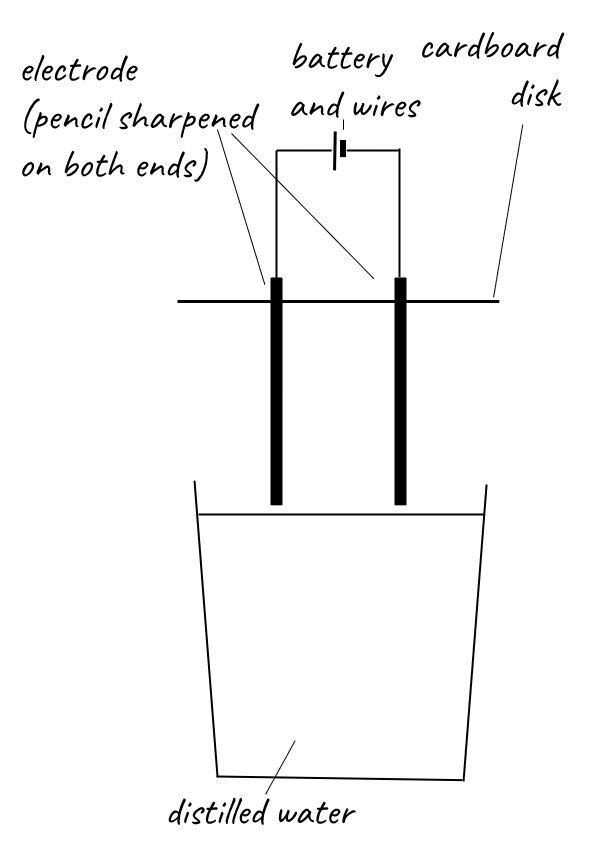
Two pencils were sharpened on both ends to expose the graphite. The pencils were pushed through small holes in a circle of cardboard of slightly larger diameter than the glass, and fixed in place with tape.
The exposed graphite on one end of the pencils was connected to the terminals of a 9V battery using wires with alligator clips.
The pencils were placed into the water (not touching each other or the glass), and the submerged pencil tips were observed.
Approximately 10ml lemon juice was added to the water, and the experiment was repeated.
Diagram
Results
When distilled water was used, nothing could be seen happening at the pencil tips.
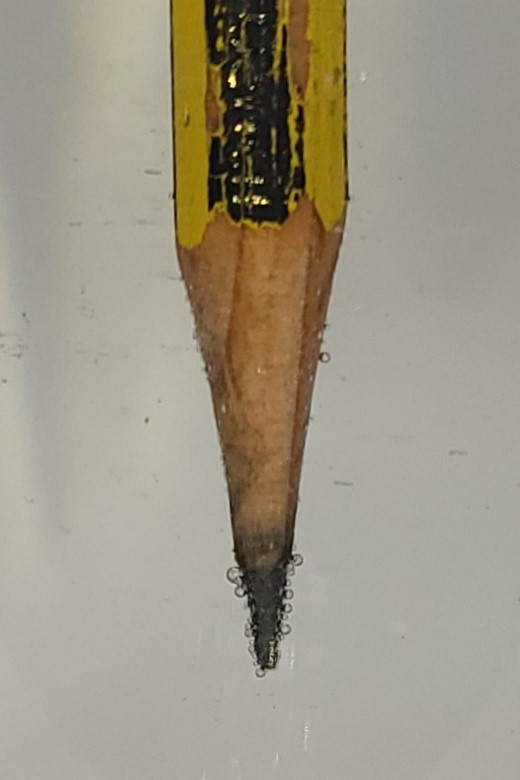
After lemon juice was added and the wires were connected, bubbles of gas could be seen forming on the exposed graphite tips of the pencils, and then rising through the water (see photo).
More bubbles could be seen rising from the cathode than the anode.
Bubbles forming at the tip of the pencil:
Conclusion
Distilled water contains few ions, so no evidence of electrolysis could be observed.
Lemon juice contains ions, and so electrolysis took place.
More gas was produced at the cathode than at the anode, because each molecule of the O2 gas produced at the anode liberates four electrons, whereas each molecule of the H2 produced at the cathode only requires two electrons.