
18. Determining the Specific Heat Capacity of a Metal
Goal
To calculate the specific heat capacity (SHC) of a metal.
Method
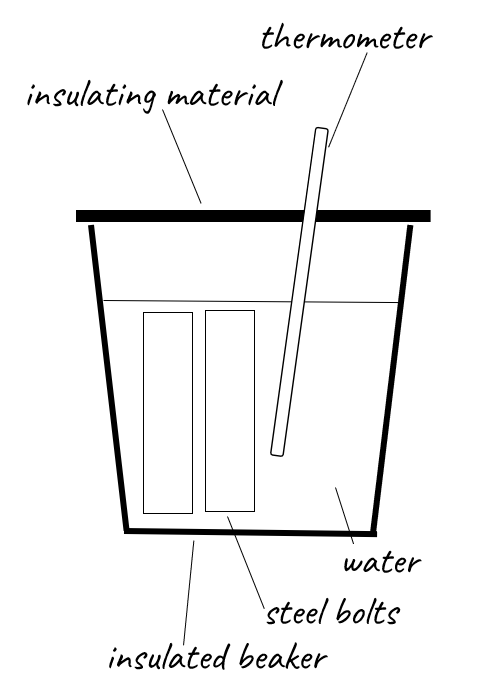
An insulted beaker was weighed.
Two steel bolts were placed into the beaker. Water was added to the beaker until the bolts were just covered. The bolts were removed and the insulated beaker with the water were weighed. The water temperature was recorded.
The steel bolts were weighed, and then placed in a pan of boiling water. The bolts were boiled in the water for 10 minutes. Tongs were used to remove the bolts from the pan and place them into the insulated beaker.
The beaker was covered with insulating material with a hole for the thermometer.
The water temperature was recorded until it stopped rising, and started to drop. The maximum temperature reached by the water was recorded.
Diagram
Results
Mass of insulated beaker = 5 g
Mass of beaker and water = 165 g
Therefore, mass of water in beaker = 160 g
Initial temperature of water in beaker = 25.8 °C
Mass of two bolts = 197 g
Maximum temperature of water in beaker = 34.5 °C
Analysis
Water gains heat energy:
| Q | = | m c ∆T |
| = | 160 × 4.2 × (34.5 – 25.8) | |
| Q | = | 5846 J |
Metal loses heat energy:
| Q | = | m c ∆T |
| 5846 | = | 197 × c × (100 – 34.5) |
| c | = | 0.45 J / (g °C) |
Conclusion
The SHC of the steel was calculated to be 0.45 J/(g °C).
The actual SHC is likely to be slightly higher due to heat loss from the bolts when they were being transferred from the pan to the beaker, and heat loss from the water while it was being heated by the bolts.