
12. Testing for Iodine in Salts
Hypothesis
Some culinary salts contain added iodine compounds.
Method
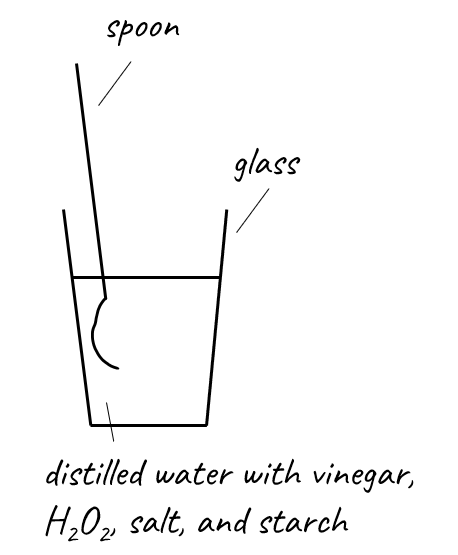
Five glasses were each filled with 100 ml distilled water.
0.5 tsp (2.5 ml) liquid starch and 10 drops of iodine antiseptic solution were added to the first glass. The contents were stirred and observed.
0.5 tbsp (7.5 ml) white vinegar and 0.5 tbsp (7.5 ml) hydrogen peroxide (H2O2) were added to each of the four remaining glasses.
25g of a salt sample and 0.5 tsp (2.5 ml) liquid starch were added to the second glass. The contents were stirred and observed.
This step was repeated with the remaining three glasses using three different salt samples.
Diagram
Results
The following observations were made when the starch was added to each of the glasses and the contents were stirred.
| Name of salt (or iodine solution) added | Observations after addition of starch and stirring |
|---|---|
| Iodine antiseptic solution | After a few seconds the solution turned a deep purple color |
| Iodized salt | After a few seconds the solution turned a deep purple color |
| Sea salt | No observable change |
| Plain salt | No observable change |
| Nu-salt | No observable change |
Conclusion
The iodine antiseptic solution and iodized salt reacted with starch to form a deep purple compound, and therefore they contain compounds of iodine.
The sea salt, plain salt, and Nu-salt did not react with starch to form a deep purple compound, and therefore they do not contain compounds of iodine.