
11b. Impact of Carbon Dioxide on Combustion
Hypothesis
Carbon dioxide can extinguish a flame by displacing the oxygen that is required for combustion.
Method
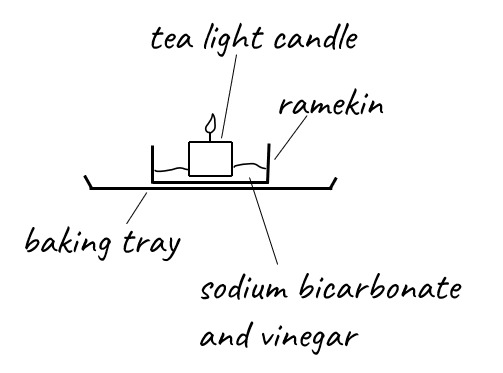
A tea-light candle was placed in a heat-proof ramekin on a baking tray.
A spoon was used to surround the candle with sodium bicarbonate, to a depth of about 0.5 cm.
The candle was lit and the flame was observed. Vinegar was poured into the ramekin until the sodium bicarbonate was bubbling up around the side of the candle, and the flame was observed as it diminished in size and then was extinguished.
After the flame had been extinguished, a lighted match was brought close to the candle in order to try to re-light it.
Diagram
Results
When it was first lit, the candle flame burned steadily.
When vinegar was added to the sodium bicarbonate it fizzed and bubbled, and the flame was extinguished.
When a lighted match was brought close to the candle, it was also extinguished.
Conclusion
Air contains enough oxygen for the candle to burn, so the candle initially burned steadily.
When vinegar was added to sodium bicarbonate, carbon dioxide was produced, causing fizzing and bubbling.
Carbon dioxide is denser than air, so it settled in the ramekin, displacing the air around the flame. Carbon dioxide does not support combustion, so the flame was extinguished.
The lighted match was also extinguished when it was brought close to the candle, because the carbon dioxide smothered its flame.