
13. Conditions Required for Rusting
Goal
To determine the conditions which are required for rusting to take place.
Method
Distilled water was poured into a pan and simmered gently in order to drive out the dissolved oxygen. The water was then allowed to cool.
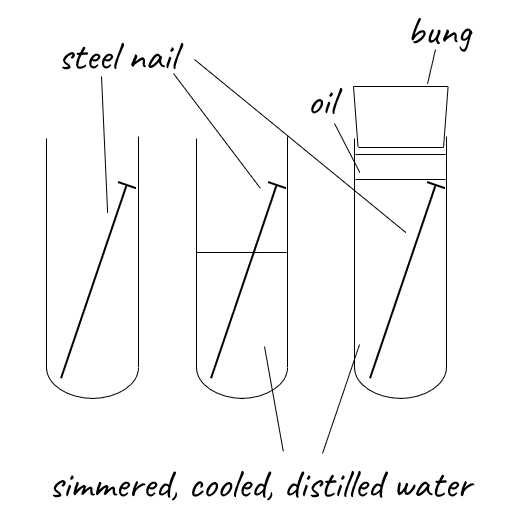
Three clean, dry test-tubes were taken, and a steel nail with no rust was placed in each.
The first was left with no water, as a control.
The second was half filled with simmered, cooled, distilled water, so that the water only partly covered the nail.
The third was filled with simmered, distilled water so that the nail was completely covered. A layer of oil was poured on top to prevent oxygen from reaching the water, and the test tube was tightly sealed with a bung.
The nails were stored upright, and closely observed for 3 days.
Diagram
Results
At the start of the experiment, no rust could be observed on any of the nails.
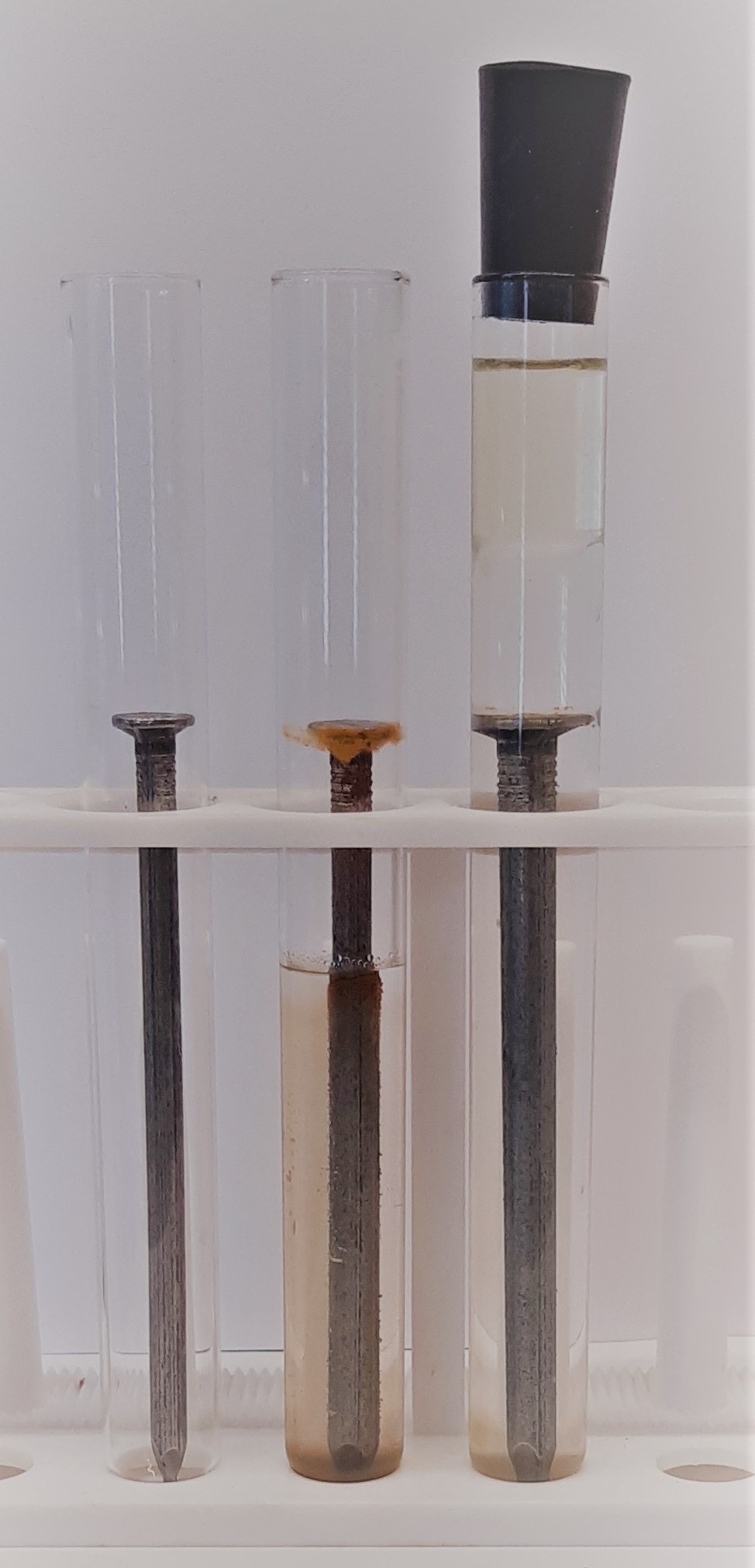
The dry nail which was exposed to the air did not rust.
The nail that was fully submerged in water but cut off from air (under a layer of oil, with a bung in the test tube) rusted very slightly during the first few hours, but did not continue to rust after that.
The nail that was partly submerged in water and also exposed to the air started to rust immediately, and continued to rust throughout the 3-day observation period.
The photo shows all three nails at the end of the observation period.
Conclusion
Iron needs both water and air (or more specifically, the oxygen in air) in order to rust.
The nail in the dry test-tube did not rust, as it was not exposed to water.
The nail that was exposed to both water and oxygen rusted continuously because it was exposed to both water and oxygen throughout the experiment.
The small amount of rusting on the nail that was not exposed to the air took place because there was a small amount of dissolved oxygen in the water at the start of the experiment. Once this oxygen had reacted with the iron to form rust, no more oxygen was available, so no more rusting took place.