
5. Decomposition of Sodium Bicarbonate
Hypothesis
When heated, sodium bicarbonate will decompose in the following way:
Sodium Bicarbonate → Sodium Carbonate + Carbon Dioxide + Water
Method
The oven was heated to 100°C (approx. 230°F).
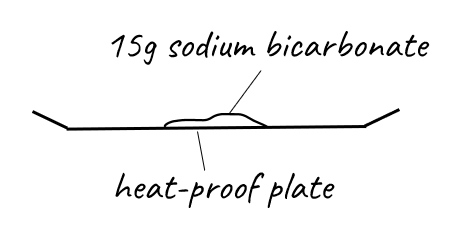
The digital scale was zeroed, the first plate was placed on it, and 15 g sodium bicarbonate was added to the plate.
The first plate was placed in the oven for 15 minutes, then placed on a heat-proof surface, observed, and then cooled for 10 minutes. The mass of the plate and its contents was measured.
The oven temperature was increased to 200°C (approx. 410°F), and the procedure repeated with the second plate.
Diagram
Results
| Mass of plate 1 before heating | 129.8 g |
| Mass of plate 1 after heating | 144.4 g |
| Mass of plate 2 before heating | 139.4 g |
| Mass of plate 2 after heating | 149.6 g |
Sodium bicarbonate is a white powder.
After heating both plates, there was a white powder on the plate which looked similar to sodium bicarbonate.
Analysis
Plate 1
Calculation of mass lost:
| Mass lost during heating | = | Initial mass of plate + Initial mass of sodium bicarbonate – Final mass of plate and product |
| = | 129.8 + 15 – 144.4 | |
| Mass lost during heating | = | 0.4 g |
Calculation of percentage mass lost:
| % Mass lost | = | (Mass lost during heating / Initial mass of sodium bicarbonate) x 100 |
| = | (0.2 / 15) x 100 | |
| % Mass lost | = | 3% |
Plate 2
Calculation of mass lost:
| Mass lost during heating | = | Initial mass of plate + Initial mass of sodium bicarbonate – Final mass of plate and product |
| = | 139.4 + 15 – 149.6 | |
| Mass lost during heating | = | 4.8 g |
Calculation of percentage mass lost:
| % Mass lost | = | (Mass lost during heating / Initial mass of sodium bicarbonate) x 100 |
| = | (4.8 / 15) x 100 | |
| % Mass lost | = | 32% |
Conclusion
Sodium bicarbonate decomposes in the following way when heated above 100°C:
Sodium Bicarbonate → Sodium Carbonate + Carbon Dioxide + Water
The reactant and product looked similar because both sodium bicarbonate and sodium carbonate are white powders.
The reduction in mass of the white powder was because the gaseous products (water and carbon dioxide) escaped into the air.
At 100°C there was only a 3% reduction in mass of the white powder. Sodium bicarbonate only begins to decompose at around 80°C, and at 100°C the reaction is quite slow. 15 minutes was not enough time to significantly decompose the sodium bicarbonate.
At 200°C there was a 32% reduction in the mass of the white powder. At this higher temperature the decomposition took place much faster, and in 15 minutes most of the sodium bicarbonate decomposed into sodium carbonate, carbon dioxide and water.