
17. Investigating Enthalpy Changes
Hypothesis
Some chemical processes release heat energy, others absorb it.
Method
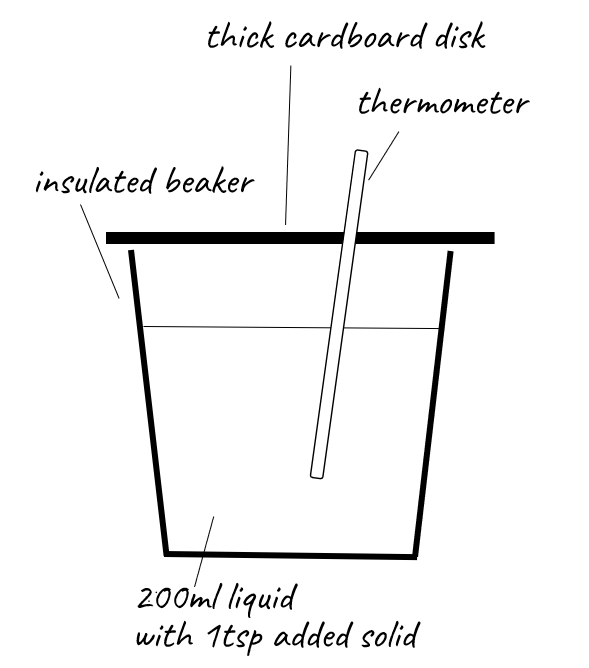
An insulated beaker was taken and 200 ml of a liquid at room temperature was added to it.
A thermometer was placed in the beaker and the temperature recorded.
1 tsp solid was added to the beaker, and a piece of thick cardboard (with a hole for the thermometer) placed on top.
The temperature of the solution was recorded every 10 seconds for 2 minutes.
The experiment was completed with four pairs of liquids and solids.
Diagram
Results
| Time (s) | Temperature (°C) | |||
|---|---|---|---|---|
| Water and Sodium Chloride | Water and Sodium O-Dodecylbenzenesulfonate | Ethanoic Acid and Sodium Bicarbonate | Hydrogen Peroxide and Yeast | |
| 0 | 25.5 | 25.5 | 25.5 | 25.4 |
| 10 | 25.1 | 25.5 | 25.4 | 25.5 |
| 20 | 25.0 | 25.6 | 24.7 | 25.8 |
| 30 | 25.0 | 25.7 | 24.2 | 26.3 |
| 40 | 24.9 | 25.8 | 23.9 | 26.9 |
| 50 | 24.9 | 25.8 | 23.7 | 27.4 |
| 60 | 24.9 | 25.8 | 23.6 | 27.9 |
| 70 | 24.9 | 25.8 | 23.6 | 28.5 |
| 80 | 24.9 | 25.8 | 23.6 | 29.1 |
| 90 | 24.9 | 25.8 | 23.6 | 29.5 |
| 100 | 24.9 | 25.8 | 23.6 | 30.2 |
| 110 | 24.9 | 25.8 | 23.6 | 30.8 |
| 120 | 24.9 | 25.8 | 23.6 | 31.3 |
Analysis
Conclusion
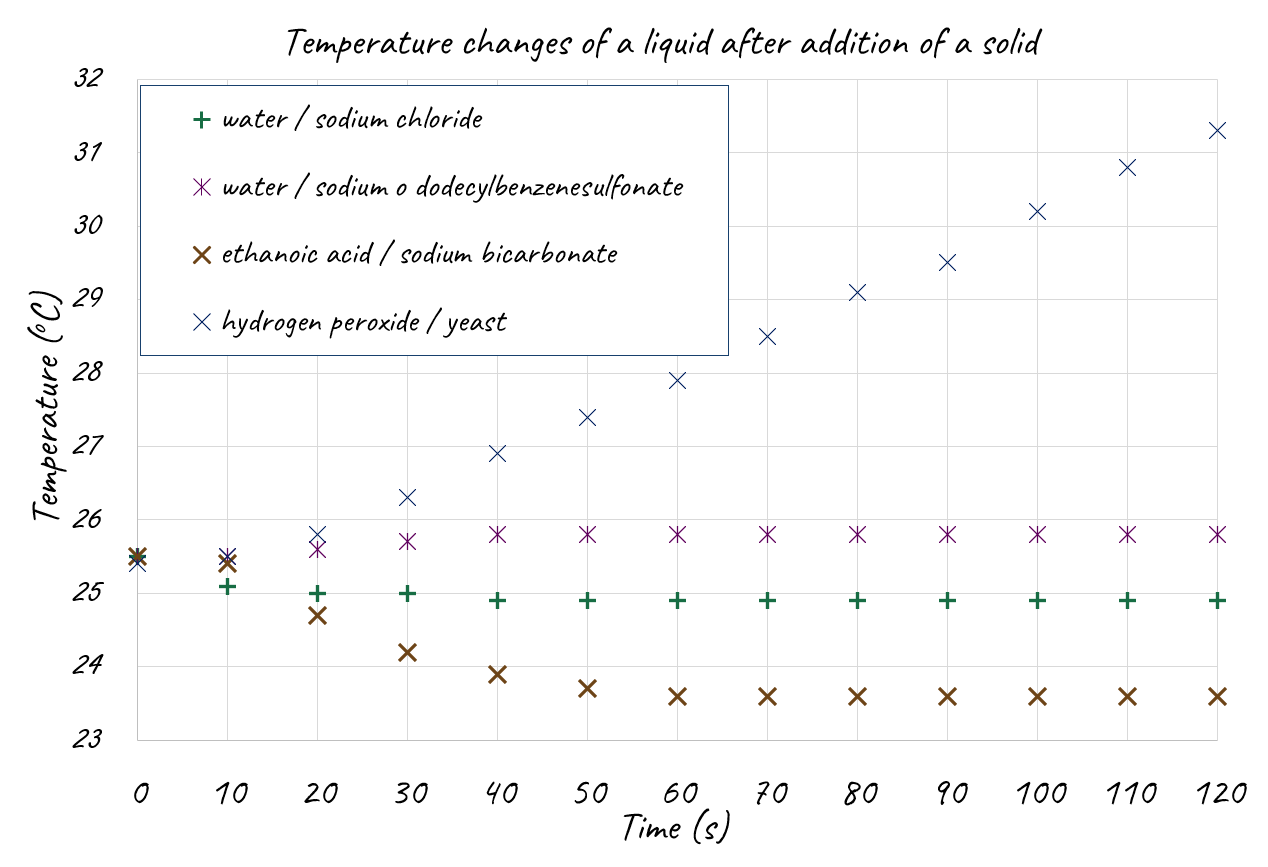
Some of the processes tested were exothermic (they release heat energy), others were endothermic (they absorb heat energy from their surroundings).
Dissolving sodium chloride in water, and the reaction between ethanoic acid and sodium bicarbonate, are both endothermic.
The decomposition of hydrogen peroxide, and the reaction between water and sodium o-dodecylbenzenesulfonate, are both exothermic.