
15. Distillation of Cream
Hypothesis
Water and liquid fats can be separated using distillation.
Method
200 ml heavy cream was measured using a measuring jug, and poured into a glass (glass no. 1).
A ramekin was placed in the base of a pan. A second sample of 200ml heavy cream was measured using a measuring jug and poured into the pan (around the ramekin, not into the ramekin). The lid was put upside down on the pan, the pan was placed on the stove, and the pan was then heated very gently for 40 minutes.
During heating, ice was placed on the lid. As the ice melted, the resulting water was absorbed with a dishtowel, and the ice was replaced.
Diagram
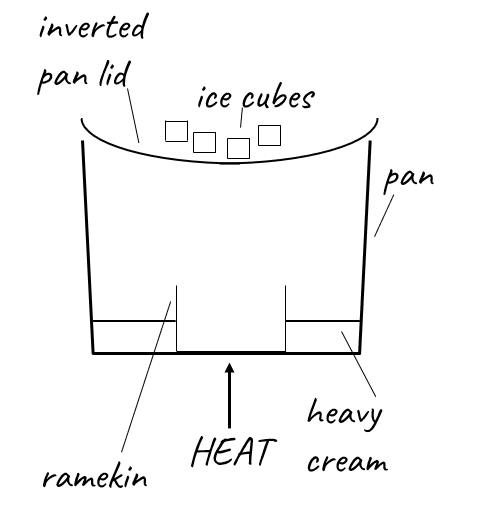
The stove was turned off, and the pan was left to cool for 10 minutes. The lid was removed from the pan. The contents of the ramekin (the distillate) was poured into a second glass (glass no. 2), and the remaining contents of the pan was poured into another glass (glass no. 3).
The contents of the three glasses were compared.
The contents of glass no. 2 and glass no. 3 were poured into a measuring jug, and the total volume was noted.
Results
The following observations were made when the starch was added to each of the glasses and the contents were stirred.
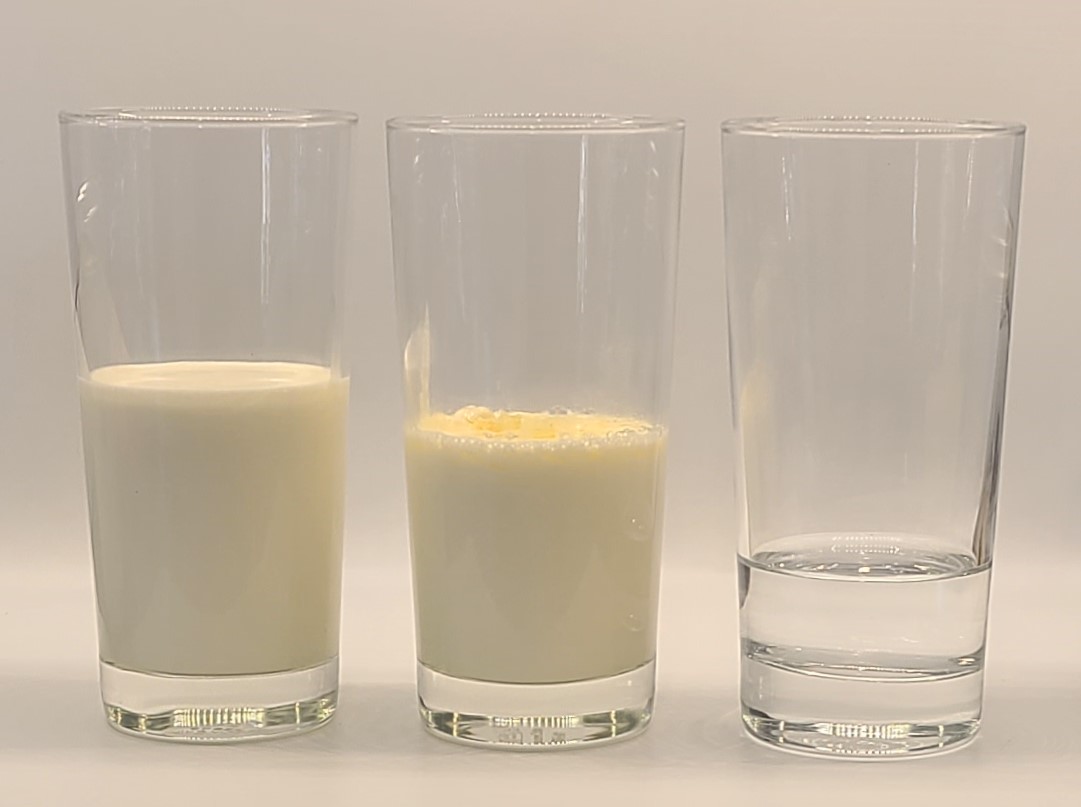
Observations of heavy cream: Creamy colored liquid, faint dairy smell.
Observations of distillate: Clear, colorless, no smell.
Observations of liquid remaining in pan: Deeper yellowish color, more viscous liquid, stronger dairy smell.
Combined volume of distillate and product remaining in pan ≈ 190ml.
The photo shows the 3 glasses at the end of the experiment. The glass on the left contains heavy cream, the middle glass contains the remaining contents in the pan, and the glass on the right contains the distillate.
Conclusion
The boiling points of water and dairy fats are sufficiently different for them to be separated by distillation.
The heavy cream was separated into two fractions. The distillate was mainly water. The liquid remaining in the pan was mainly dairy fats. These fats melt between -40°C and 40°C, and so some of these solidified at room temperature.
Approximately 10% of the volume of the cream was lost. Some evaporated under the rim of the lid or through the vent hole, some was left in the pan or on the lid.