
11a. Impact of Oxygen on Combustion
Hypothesis
When all the oxygen has been consumed, combustion will end.
Method
Each glass was weighed, filled to the brim with water, then weighed again, in order to determine the mass of water (and hence the volume of air) that each glass could contain. The glasses were then emptied and dried.
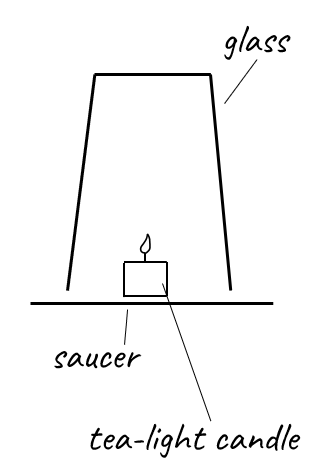
The tea-light candle was placed on the saucer and lit. The smallest glass was then placed over the lit candle in order to confirm that this would cut off the oxygen supply and the flame would be extinguished.
The flame was relit, the smallest glass was placed over it as before, and the timer was started. The timer was stopped when the flame was extinguished, and the time was recorded. This step was repeated for each glass.
Diagram
Results and Analysis
When lit, the candle flame burned steadily.
When a glass was placed over the candle, the flame gradually reduced in size, before finally being extinguished.
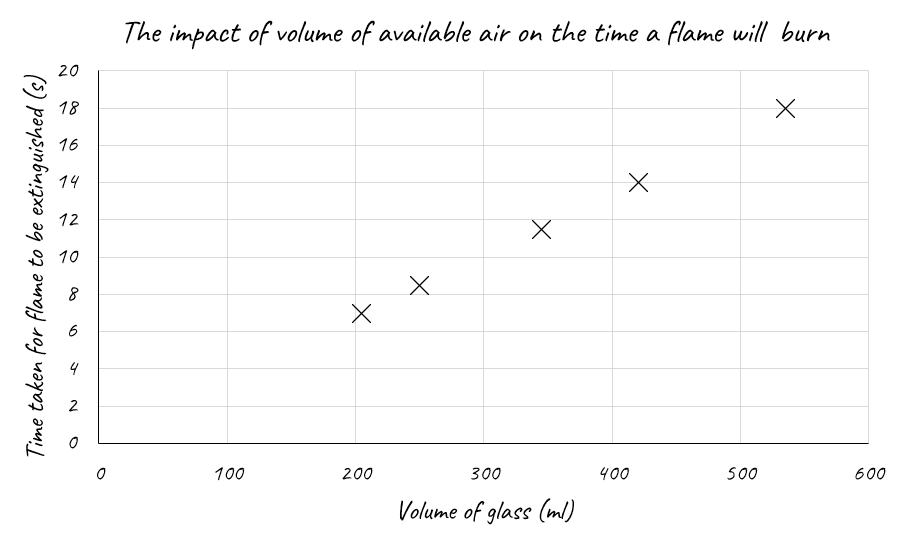
| Mass of Empty Glass (g) | Mass of Glass Full of Water (g) | Volume of Air in Glass (ml) | Time Taken for Flame to be Extinguished (s) |
|---|---|---|---|
| 168 | 373 | 205 | 7.0 |
| 183 | 433 | 250 | 8.5 |
| 232 | 577 | 345 | 11.5 |
| 315 | 736 | 421 | 14.0 |
| 494 | 1029 | 535 | 18.5 |
Conclusion
The candle burned steadily in air when no glass was placed over it, because plentiful oxygen was available.
When the glass was placed over the candle, the oxygen supply was cut off. As the oxygen was used up, the flame became smaller. Once all the oxygen had been consumed, combustion stopped and the flame was extinguished.
Larger glasses contain more air (and therefore more oxygen), and therefore allowed the flame to burn for longer. The burn time was approximately proportional to the volume of the glass.
The results do not show a perfectly proportional relationship for several reasons: (1) The time measurements were not perfectly accurate (only to the nearest 0.5 s); (2) Some of the volume of the glass was taken up by the candle itself; and (3) The rate of oxygen consumption varied as the flame grew smaller just before being extinguished.