
10. Measuring the Percentage of Oxygen in Air
Hypothesis
Steel wool will no longer rust when all the available oxygen has reacted.
Method
A small piece of steel wool was dipped in vinegar to remove its protective coating. This allows the iron in the steel wool to rust (i.e. react with oxygen).
The steel wool was rinsed in distilled water, and placed at the bottom of a measuring cylinder.
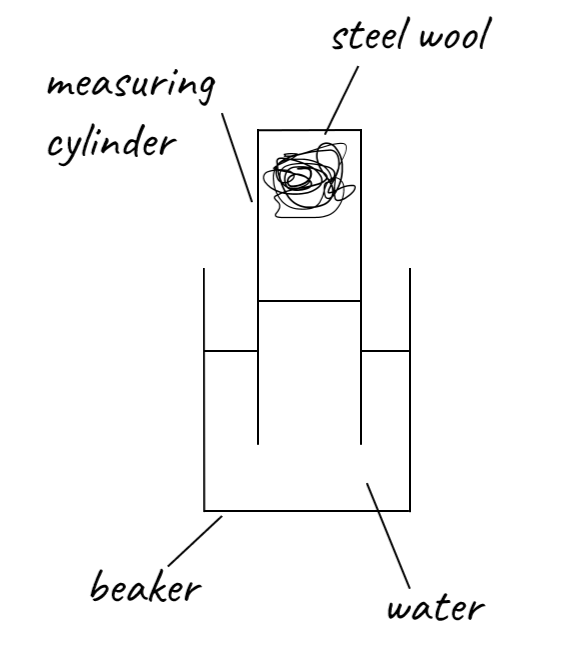
The measuring cylinder was partially filled with tap water, and then placed upside down in a beaker of water. The height of the column of air was recorded.
The apparatus was left and the height of the column of air was recorded until it no longer continued to change.
The steel wool was examined to determine whether it was fully rusted or only partially rusted.
Diagram
Results
As the reaction progressed, the water level in the measuring cylinder rose, and the height of the air column decreased.
When the reaction ended, the steel wool had only partially rusted.
| Time (hours) | Height of Air Column (cm) |
|---|---|
| 0 | 8.6 |
| 0.5 | 8.4 |
| 1 | 8.2 |
| 1.5 | 7.8 |
| 2 | 7.4 |
| 2.5 | 7.2 |
| 3 | 6.8 |
| 3.5 | 6.8 |
| 6 | 6.8 |
| 24 | 6.8 |
Sodium bicarbonate is a white powder.
After heating both plates, there was a white powder on the plate which looked similar to sodium bicarbonate.
Analysis
| Volume Change of Air | = | ((Initial Volume – Final Volume) / (Initial Volume)) x 100 |
| = | ((8.6-6.8)/8.6) x 100 | |
| Volume Change of Air | = | 21% |
Conclusion
After 24 hours, the reaction had stopped, but the steel wool had only partially rusted. This indicates that the reaction stopped because all the oxygen had been used up, not because all the steel wool had rusted.
Iron requires oxygen to rust, and the reaction stopped when 21% of the air volume had been consumed. Therefore, the air contained 21% oxygen prior to the start of the reaction.