
9b. Measuring the Impact of Concentration on pH
Goal
To demonstrate that the pH of an acid varies with concentration.
Method
The pH of a sample of vinegar was determined using litmus paper.
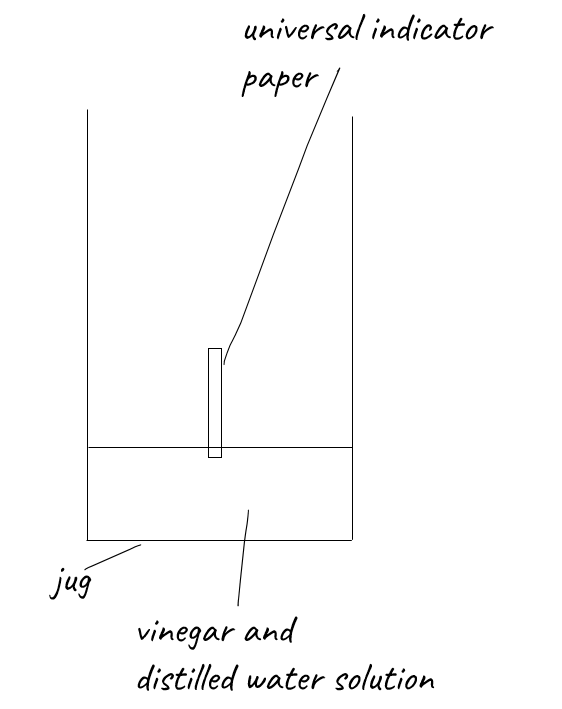
1 tsp (5 ml) of the vinegar was placed in a jug. 50 ml distilled water was added to the jug, and litmus paper was used to determine the pH of the solution.
A further 100ml distilled water was added to the jug, and the pH was determined. This step was repeated until the addition of water had no discernible effect on the pH of the solution.
Diagram
Results
| Total Volume of Water Added (ml) | pH |
|---|---|
| 0 | 2 |
| 50 | 3 |
| 150 | 3 |
| 250 | 3 |
| 350 | 4 |
| 450 | 4 |
| 550 | 4 |
| 650 | 4 |
| 750 | 4 |
| 850 | 5 |
| 950 | 5 |
| 1050 | 5 |
Conclusion
The pH increases with the addition of water because the concentration of H+ ions in the vinegar-water solution reduces.
Eventually, if enough water is added, the solution will have a pH very close to 7 because the concentration of H+ ions will be very low (close to zero).
The pH will not increase above 7 because water itself is neutral, with a pH of 7.The addition of a neutral liquid to an acid cannot produce an alkaline solution.