
1. Solubility of Sodium Chloride in Water
Hypothesis
The amount of sodium chloride that will dissolve in a given volume of water will vary with temperature.
Method
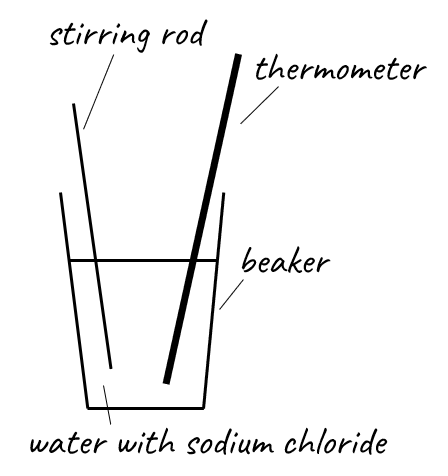
100 g of chilled distilled water was poured into an insulated beaker. 25 g sodium chloride was added to the water and stirred until all the crystals had dissolved.
A further 1 g sodium chloride was added, and the water stirred until all the crystals had dissolved.
This step was repeated until undissolved salt crystals could be seen in the beaker after stirring. When crystals could be observed after stirring, a thermometer was used to measure the water temperature.
The experiment was repeated 3 times with water at higher initial temperatures.
Diagram
Results
| Water Temperature (°C) | Mass of Sodium Chloride added (g) |
|---|---|
| 12 | 35 |
| 35 | 36 |
| 56 | 37 |
| 76 | 38 |
Analysis
Conclusion
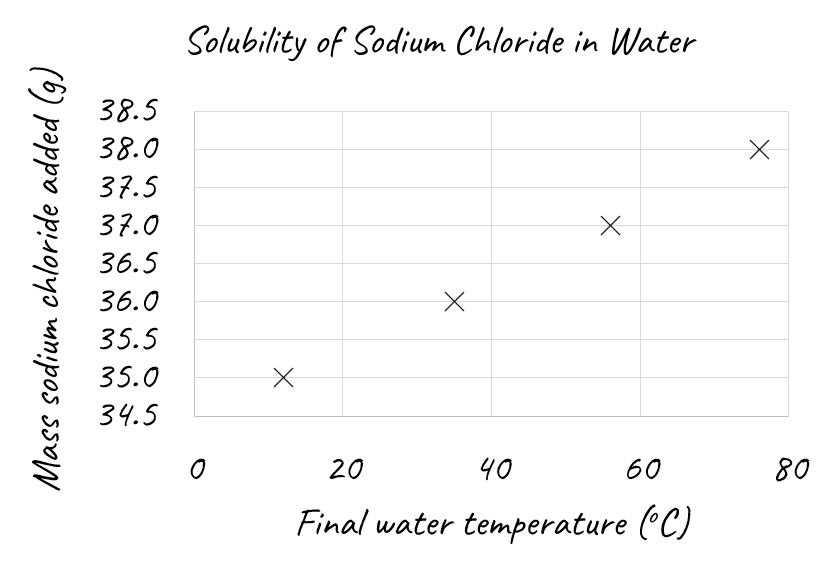
The mass of sodium chloride which dissolves in a given volume of water increases with temperature.
Inaccuracies in the results came from adding relatively large amounts of salt (1 g) between observations, inaccuracies in measuring the volume and temperature of the water, and difficulty in determining whether or not all the salt crystals had dissolved.