It’s surprisingly common for high-school science classes to be taught by non-specialist teachers.
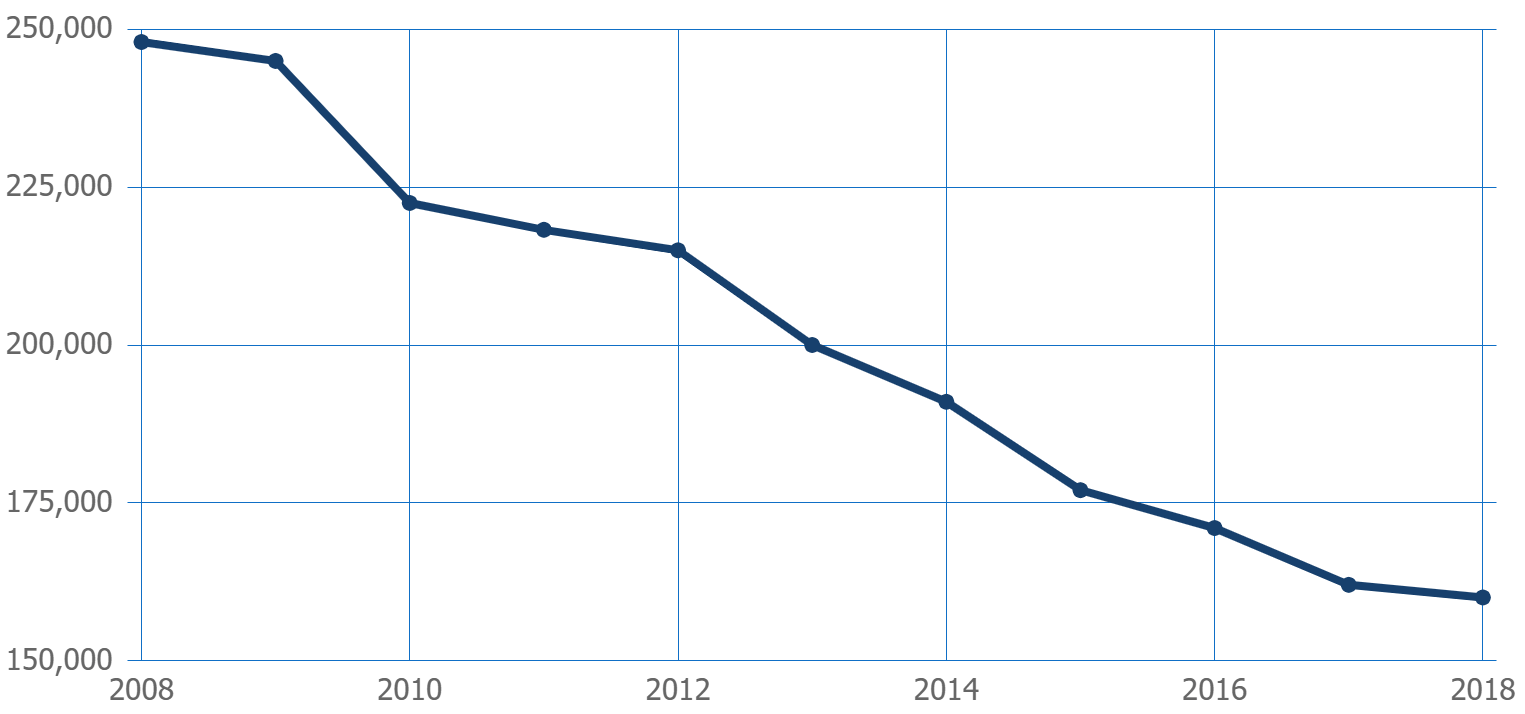
As far back as 2000, a staggering 64.8% of US public high school teachers in the physical sciences lacked an undergraduate or graduate major in the subject. And as the Brookings Institution noted more recently, “The STEM teacher workforce is facing strong headwinds. The pipeline of new teachers has been struggling to meet demand, and many schools have reported difficulties in staffing STEM positions.” The STEM staffing problem looks set to continue.
Perhaps surprisingly, private schools seem to have greater difficulties finding specialist STEM teachers than public schools. The National Center for Education Statistics notes that “greater percentages of teachers in private high schools taught out of field in mathematics [and] science…than did their counterparts in public high schools.”

Less surprisingly, smaller schools have the hardest time of all — “high schools with the lowest enrollments had greater percentages of teachers teaching out of field than did the largest schools.”
Smaller schools have the hardest time of all
The message is clear: If you’re a teacher at a small school or a member of a homeschool co-op, and you’re working hard to teach a high-school science class that you’re struggling to understand, you’re definitely not alone.
How can you teach high school chemistry if you’re not a specialist?
We all recognize that teaching outside our area of expertise is far from ideal. Out-of-field teachers often find themselves learning content one day and teaching it the next. They work hard to get to grips with the material, but they often have to resort to reading scripted lessons, avoiding advanced concepts, or encouraging students to research topics on their own. Online teacher forums can be helpful, but they’re unlikely to provide the ongoing support needed by teachers struggling with unfamiliar material.
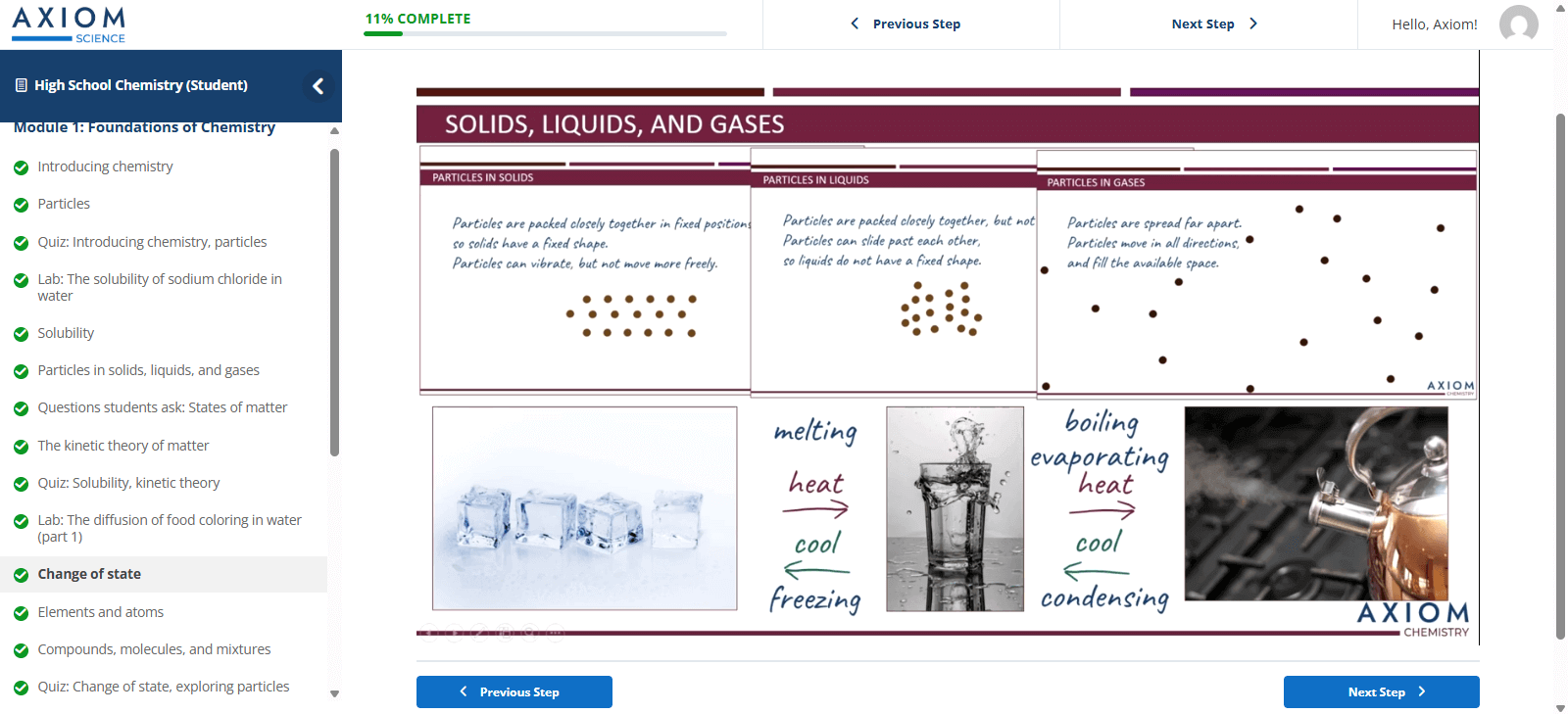
At Axiom Science, our goal is to provide an alternative that really works. We provide a structured course that a classroom teacher can oversee, but we take care of all the teaching. We cover the entire chemistry curriculum, with automatically-graded quizzes and user-friendly labs with clear grading guidelines. The modular structure helps you to guide your students through the complete curriculum.
At Axiom Science, our goal is to provide an alternative that really works
The course includes over 150 short videos. Some videos teach new concepts, others lead your students through worked examples, with others giving helpful module summaries, walking you through experiments, or posing (and answering) common questions which students ask. There are 50 instant-feedback quizzes (almost 60 in IGCSE), each with full worked solutions, and a complete set of hands-on experiments using everyday supplies (no expensive equipment needed).
Check out this article if you want more details about exactly what’s in the box. Or read on, and discover how Axiom Science can help you in your particular classroom scenario.
How can I use Axiom Science in my classroom?
Every teacher is in a different situation, with different class sizes, different facilities, and different timetables. However, Axiom Science provides classroom-ready chemistry resources that are flexible enough to work in many different contexts. Take a look at the three scenarios below to see how Axiom Science could work for you.
Scenario 1: Small school, medium sized class, 2 lessons per week
I teach in a small school, with 15 students in my class. I have two 90-minute lessons per week, and the students are then expected to complete some homework. I have access to a large screen in the classroom, and a basic lab with work benches, running water, and a refrigerator. The children are not permitted to bring their own computers into the classroom.
Stay involved
With 3 hours of class time and access to a basic lab, you’ll be able to supervise your students closely, and lead them through all of the teaching yourself.
Use the big screen
We suggest you use your large classroom screen to work sequentially through the videos — all you need to do is make sure that your students are taking notes to refer back to. When you get to a worked example, you may want to pause the video and let them try and work it out for themselves, and then watch the full solution together. Labs can be completed together too. Why not watch the video, head down to your lab to complete the practical work, and then — if time permits — complete the lab report back in the classroom? Or, if you run out of lesson time, the lab report could be completed at home.
Quizzes at home
The quizzes are perfect for homework, allowing your students to use their own computers. You can use your supervisor dashboard to track your students' progress and see their scores instantly.
Progress
With 3 hours of class time per week, plus homework, you should have no problem completing the material within the suggested 1 year timeframe. This will be helpful with a class of 15, as you'll be able to allow time for slower students to keep up.
Scenario 2: Small school, small class, 2 shorter lessons per week
I teach in a small university-model school with 5 children in my class. I have two 50-minute lessons per week, and the students are then expected to complete 2 hours of homework. I have no lab facilities and no large computer screen, but the students all bring their own computers into the classroom.
Follow the university model
University model schools allow for a fruitful balance of class time and home-based study. With just two 50-minute lessons each week in class, the students should expect to devote more time to the course at home. The flexibility of their home-based study allows them to devote more time to complex topics where necessary.
Gather round the small screen
We suggest you use your own computer to work through the videos together with your students in the class. This will support the small group setting well, and with just a few students everyone should still be able to see the screen. You’ll need to encourage the students to keep taking adequate notes. You may also want to pause the video occasionally to make sure everyone is keeping up, or to give the students a chance to attempt a worked example themselves before watching the full solution together.
Quizzes at school or home
Because each student has their own computer, quizzes can be completed in the classroom whenever they appear on the course schedule. Alternatively, the students could complete the quizzes at home, and you can track their progress and results using your supervisor dashboard.
Homework and labs
The students will likely need to complete some of the videos and quizzes at home. Home is also the place for the hands-on labs if your school doesn't have suitable lab facilities. You may want to watch the lab video together in class, to ensure that the students understand what the labs involve. You may also want to notify parents of the supplies they'll need — an easy task using our online lab materials guides.
Scenario 3: Homeschool co-op, 1 lesson per week
I teach in a small homeschool co-op, and we meet once a week in a friend’s house with access to a kitchen. We have 1 hour per week set aside for chemistry, and the students are then expected to complete several hours of homework. Our students are used to working independently, but enjoy interacting when they are all together.
Independent study
We suggest that your students work independently through the video lessons and quizzes. You can use the online schedule to set the work for each week, and keep track of student progress and quiz scores using your supervisor dashboard.
Maximize interaction by doing labs together
You’ll want to maximise the student’s interaction during the time they spend time together, and the labs are the best way to do this. All Axiom Science labs can be completed in a regular kitchen with widely available supplies. You may sometimes find that the labs can't be scheduled for exactly the point at which they appear in the course. This is completely fine — we recommend including them a little later so that the students understand the concepts before doing the practical work.
Additional interaction during class time
If you have additional class time, we recommend prioritizing the "Questions Students Ask" videos or worked example videos, as these lend themselves readily to group discussion.
Axiom Science courses are designed to be flexible enough for use in a variety of different settings. Our goal is to give you the tools you need to give the best possible science education to the children you love. Why not register for a free account today, and take a look at our sample course.