The Science of Effective Teaching: Three Evidence-Based Principles for Lasting Understanding
Introduction
As every parent and teacher knows, designing a really engaging, exciting, and effective course isn’t easy.
A great deal of research has been done in recent decades to identify the most effective teaching methods. Some of the results have been exactly what experienced teachers might expect, while others have been more surprising.
Axiom Science courses reflect the principles uncovered by this work, with the goal of equipping you to provide the best possible learning opportunities for your children. Here are three important principles that characterize the most effective approaches to teaching.
Principle 1: Long-term study beats cramming
In a landmark paper published in Psychological Science, Nicholas Cepeda and his colleagues examined the effects of different study schedules on a total of 1350 participants. They finally proved what many teachers and students have known (or at least suspected) for a long time: Cramming immediately before a test may improve test scores, but the material learned is quickly forgotten. By contrast, if you really want to develop and retain understanding of a subject in the long term, it’s necessary to study and review the material repeatedly over an extended period of time.
Imagine two groups of students. The first group receives all their teaching in a single session, while the second group receives the same amount of teaching divided into two sessions spaced a few days or weeks apart. Members of each group are then tested at intervals to determine how much they will be able to remember after the teaching is finished. The key question is this: How much knowledge will each group be able to remember as the months go by?
The gray line shows what happens to test scores if all the teaching is squeezed into a single session. This simulates the effect of cramming. By contrast, the blue line shows the results of dividing the same amount of teaching into two separate sessions.
The effects of a single review session on knowledge retention over time
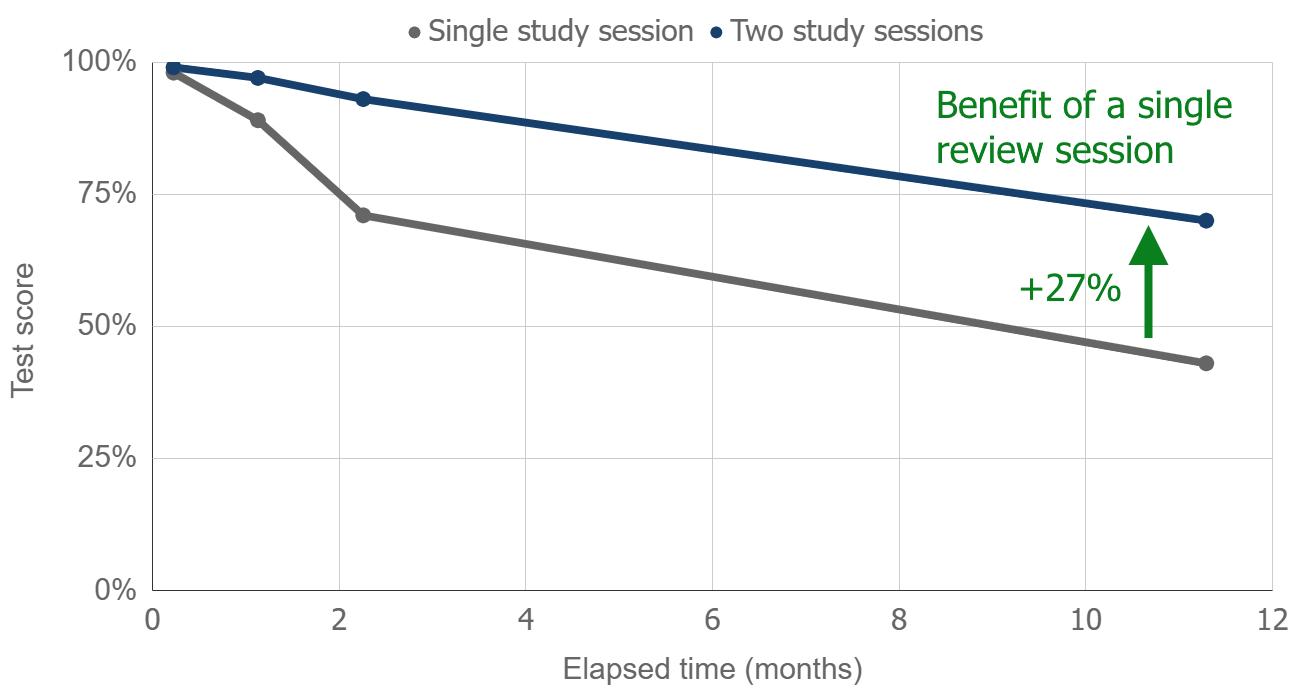
Predictably, both groups score nearly 100% initially, the scores in both groups decline over time. But the scores in the single session group decline much more rapidly, dropping to 43% after almost a year, while the students who received two separate study sessions retained 70% of what they had learned.
That’s a 27% improvement in test scores — quite a bonus for your students! And remember: that comes from just a single review session, with no overall increase in study time. Adding extra reviews during the year would obviously improve performance even more. Indeed, Cepeda and his colleagues explain that in some circumstances a single review session can double the amount of material remembered.
These results have profound implications for course design. Traditionally, many courses work through individual topics one by one, perhaps testing as they go, but once a topic has been covered, the students never return to it again. This is a highly inefficient way of teaching. The earlier material gradually fades from memory, and by the end of the course the students have forgotten most of what they learned at the beginning. If there is a final test, students who spend a few days frantically cramming are likely to get a better score. But none of them will be able to remember much in the long term.
You can probably identify personally with this experience. How much can you really remember about what you studied at school?
You can probably identify personally with this experience. How much can you really remember about what you studied at school? You can probably recall some of what your learned, but only in subjects that really captured your imagination, or which you later studied at a higher level, or which you returned to in your professional life. Those topics continued to percolate through your mind, week by week, month by month, and year by year, with the result that you can still recall them vividly decades later. By contrast, in other subjects, you may have passed the test, but they’re now long forgotten.
Axiom Science courses are designed differently. All our courses are carefully structured to provide regular, repeated reviews of all the topics studied. The process of learning is truly cumulative. At every stage, students revisit and build on what they covered previously, so that all the material is repeatedly engrained, and new ideas are added in a way that gradually builds towards a comprehensive, coherent, and (crucially) memorable grasp of the whole subject.
Yes, this is great! I get this!
This approach to learning is much more rewarding for the students themselves. Of course, some students may feel uncertain when they encounter new ideas for the first time. But as they progress through the course, they return again and again to those same topics from different angles, and gradually everything starts to make sense. Over time, students start to get that tremendously rewarding feeling, “Yes, this is great! I get this!”
Principle 2: Well-designed tests improve retention
No one really likes tests, and of course we all recognize that it’s possible to have too many of them. Children don’t grow taller simply by being measured every day; in the same way, just testing and retesting over and over again doesn’t help children learn. Too much testing can be discouraging and stressful, and reduces the time available for actual teaching.
However, testing does have a place in a well-designed teaching process. Specifically, the best teaching structures strike a balance between introducing new material, integrating it with what has already been learned, reviewing material week by week, and giving students the opportunity to ingrain their knowledge through well-structured quizzes and tests.
In an authoritative 2006 article entitled “The Power of Testing Memory,” psychologists Henry Roediger and Jeffrey Karpicke describe what they call “the testing effect” — namely, the “surprising phenomenon” whereby “tests enhance later retention more than additional study of the material.”
Their extensive review includes not just laboratory-based studies, but also the application of the results to real-life educational settings. Their conclusion is clear: “Frequent testing in the classroom may boost educational achievement at all levels of education.”
Testing does have a place in a well-designed teaching process
Other studies explain the mechanism behind the testing effect. The bottom line is simple: the very act of retrieving an idea from memory during a test or other assessment is what psychologists call a learning event — that is, a cognitive process that produces a lasting change in knowledge or understanding. The impact of such a first-hand learning event is much more profound and long-lasting than merely hearing an explanation from someone else.
If you’re a home-educating parent or teacher, you’ve almost certainly experienced something like this yourself. Perhaps you encountered an idea that’s new and intriguing to you, and you thought to yourself, “I should definitely include that in my teaching sometime.” At the time, it seems clear in your mind — you’re sure you understand it. But later, when you’re preparing to share it with your students, you get into a bit of a tangle. You realize that you didn’t understand the new idea quite as well as you had imagined. You’re forced to think hard, perhaps to re-read the material again, and only then does it become clear enough in your mind that you can explain it well to your class.
That’s the testing effect in action. The original encounter was your “lesson,” and the lesson preparation was your “test”. That lesson prep was a highly effective learning event for you — just like a test, it forced you to recall more clearly what you thought you already understood. Initially, you discovered to your surprise that you didn’t understand it as well as you thought you did! Wonderfully, your lesson prep also had the effect of crystallizing the idea in your mind, so that when you taught it to your students, it was clear and exciting for them.
Axiom Science courses are designed to take advantage of the testing effect… to get beyond superficial familiarity and achieve true mastery of the subject
Axiom Science courses are designed to take advantage of the testing effect. Our High School Chemistry course includes 50 quizzes, spaced out among almost 200 video lessons and reviews, along with 20 hands-on labs, with the aim of enabling students to get beyond superficial familiarity and achieve true mastery of the subject. Our IGCSE Chemistry course includes even more material — an entire additional module dedicated to exam preparation. When your students hear “Quiz,” encourage them to think, “This is my opportunity to really get to grips with what I’ve learned!”
Of course, we don’t want our students to find the quizzes stressful. We also recognize that everyone can have a bad day, and we don’t want a student’s grade to be impacted negatively by a few careless mistakes. Paradoxically, having plenty of quizzes addresses these concerns very well, because each individual quiz makes only a small contribution to the overall grade. All our quizzes include a blend of easier and more challenging questions, giving students of different abilities a chance to shine. We avoid the all-or-nothing anxiety of a single final exam, and enable students to show what they’ve learned week by week as they progress through the course.
Principle 3: Desirable difficulties produce the best results
This is probably the most controversial principle — at least for students! But it’s the one that has the potential to produce the greatest long-term fruit in the lives of your children, and in the end, it’s the most encouraging.
Over 25 years of research, the husband-and-wife team of Robert and Elizabeth Bjork at UCLA have developed what they call the “desirable difficulties” theory. The central idea is this: The right kinds of intellectual challenge can dramatically improve the effectiveness of teaching by encouraging students to engage deeply and actively with the material before them. The increased cognitive load is hard work, but produces fantastic results.
Of course, not all difficulties are desirable. Badly designed teaching can be difficult in ways that are profoundly unhelpful:
- Muddled explanations: This is a very common form of undesirable difficulty. Muddled and disorganized teaching just create confusion, and too many new ideas introduced too quickly leave students overwhelmed.
- Lack of integration: If educators fail to integrate new themes into existing material, or don’t include regular reviews, students will be unable to connect the various topics into a coherent whole, and everything will quickly be forgotten.
- Lack of feedback: The most effective feedback is clear, specific, and supplied immediately after the work is done. Without this, mistakes will tend to become ingrained.
- Distracting or irrelevant material: This increases cognitive demand without focusing the students’ minds on what’s important.
Not all difficulties are desirable… pedagogical mistakes create undesirable difficulties — they make lessons more difficult without helping students learn
All of these pedagogical mistakes create undesirable difficulties — they make lessons more difficult without helping students learn, and many students will become discouraged and give up.
But desirable difficulties are very different. The most effective teaching introduces new ideas in a way that is intriguing and challenging, yet manageable. It makes frequent connections to themes introduced previously, so that students gradually build up a coherent picture of the whole subject. The quizzes discussed above form part of this picture, prompting students to recall previous material in different contexts, and providing clear feedback so that even mistakes become valuable learning events. And science courses in particular offer unique opportunities to increase students’ motivation by making frequent connections to real-world practical applications of scientific principles.
Try Axiom Science Risk-Free
7-Day Money-Back Guarantee
Every Axiom Science course comes with a 7-day money-back guarantee. Explore the lessons, try the labs, and see how the course works for you. If it’s not a good fit, just email us within 7 days and we’ll give you a full refund — no forms, no hassle, no questions asked.
Choose the chemistry course that fits your curriculum, explore the full course details, and start learning today.
Try Axiom Science Risk-FreeAlternatively, take a look at our free course preview to see sample lessons.
Try free preview